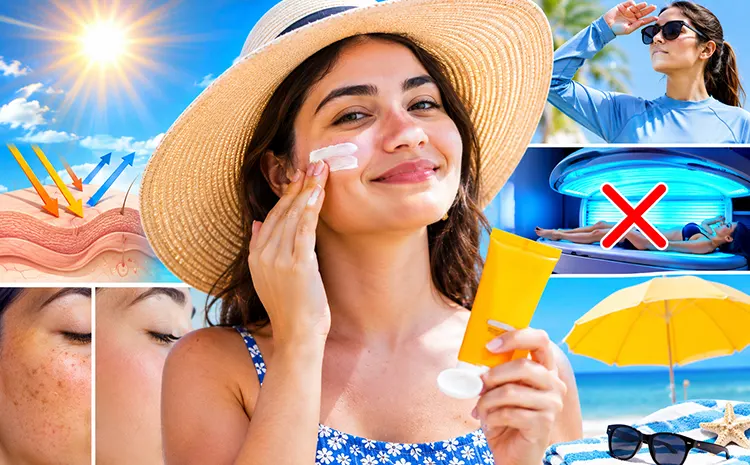
30 degrees Celsius, a light breeze. We blissfully stretch out on our beach towels from morning until night. Our skin is dusted with the soft sand; the sun glitters tirelessly on the water’s surface. Doesn’t that sound like a dreamy summer holiday day? Not if you ask our skin. Many people still underestimate the danger of excessive UV radiation, partly because myths about sun protection continue to circulate.
Below Are The 7 Sun Protection Myths Debunked
Myth 1: A Little Bit of Sunburn Isn’t Dangerous
When you’re out in the sun, it’s critical to know that too much exposure to its ultraviolet rays can be bad news for your skin. These rays can damage the DNA in your skin cells, which can lead to skin cancer over time. If you get sunburned a lot or spend a lot of time outside without protecting your skin, you’re at a higher risk.
Even if the sun doesn’t feel super strong, you still need to be careful—both UVA and UVB rays can cause damage. And it’s not just being outside that’s the problem; using tanning beds regularly can also increase your risk of skin cancer. So, remember to take care of your skin and protect it from the sun; it’s one of the best ways to prevent skin cancer.
Whether and how much damage it causes depends, among other things, on the duration of exposure, the intensity of the rays, one’s skin type, and age. The risk is particularly high for people who frequently get sunburned, have many moles, or have a weakened immune system.
Sunburns in childhood and adolescence often lead to skin cancer in middle adulthood. Those who regularly use tanning beds are also at risk due to repeated UV exposure.
Myth 2: Sunscreen Is Not Necessary in Bad Weather
Yes. On warm summer days, we feel the sun’s power very clearly on our skin. However, under overcast skies, wind, and cold temperatures, UV radiation is easily underestimated, and sun protection is often neglected. Yet, even with light cloud cover, up to 75 percent of UV radiation reaches the ground—and unprotected skin.
UV radiation, on the other hand, is easily underestimated, and sun protection is often neglected. Even under light cloud cover, up to 75 percent of UV radiation reaches the ground—and also unprotected skin.
One reason for this phenomenon is that UV light because of its longer wavelength, penetrates clouds much better than heat radiation or visible light. So, even when it gets cooler or darker due to cloud cover, the UV rays still get through. Furthermore, radiation exposure depends not only on cloud cover thickness and temperature but also on other factors, such as time of day and year, proximity to the equator, and altitude.
Due to its longer wavelength, UV light penetrates clouds much better than heat radiation or visible light. Therefore, even when it gets cooler or darker due to cloud cover, UV rays still penetrate. Furthermore, radiation exposure depends not only on cloud cover thickness and temperature but also on other factors, such as time of day and year, proximity to the equator, and altitude.
Myth 3: There Is No Risk of Sunburn in the Shade
That’s short-sighted. The fact is, shade reduces UV radiation. However, this reduction is not as significant as many people assume. According to the Federal Office for Radiation Protection, radiation exposure under a parasol is only about ten to 30 percent lower, and under a tree with a dense canopy, it’s about 20 percent lower UV radiation.
However, this reduction is not as significant as many people assume. According to the Federal Office for Radiation Protection, radiation exposure under a parasol is only about ten to 30 percent lower, and under a tree with a dense canopy, approximately 20 percent lower.
Even if the fabric of the parasol is UV-blocking, scattered radiation from bodies of water, buildings, or snow can still have an effect. So, even in the shade, we can get sunburned if we stay there too long without protection. Because it’s less hot there, however, we often don’t realize how much radiation we’ve been exposed to until it’s too late, and we should take extra care.
Even if the sun is UV-blocking, scattered radiation from water surfaces, buildings, or snow can still have an effect. So, even in the shade, we can get sunburned if we stay there unprotected for too long. Because it’s less hot there, however, we often don’t realize how much radiation we’ve been exposed to until it’s too late, and we should take extra care.
Myth 4: People Who Wear Clothes Don’t Need Additional Sun Protection
Please take a closer look. The most effective way to prevent sunburn is to avoid exposing your skin to radiation in the first place.However, since we want to enjoy afternoons at the lake or hikes in the mountains, we should cover as much skin as possible..
Even if we protect our arms and legs with long-sleeved clothing and our neck, forehead, ears, and head with a hat, we can’t always avoid using sunscreen. Depending on the fabric density and color of the clothing, around 30 percent of UV light can still penetrate to the skin.UV light penetrates the skin.
Those who are exposed to very strong and prolonged radiation should also apply sunscreen. Alternatively, special clothing with a sun protection factor allows you to go out in the sun without significant health risks.
Especially for children, there are specially tested and certified UV-protective textiles that protect their sensitive skin from damage. Athletes can also benefit: Clothing with UV protection according to UV Standard 801 even protects when wet and stretched. UV-protective textiles that protect your sensitive skin from damage. Athletes can also benefit: Clothing with UV protection according to UV Standard 801 even protects when wet and stretched.
Myth 5: Sun Protection Factor 15 Ensures a Healthy Tan
A common misconception: the higher the sun protection factor (SPF) of a sunscreen, the less UV radiation penetrates the skin. Conversely, many believe that a lower SPF will give them a healthy tan. The higher the SPF of a sunscreen, the less UV radiation penetrates the skin. Conversely, many people believe that a lower SPF will give them a healthy tan.
It is true that the sunscreen filters contained in creams or lotions prevent skin damage by absorbing, reflecting, or scattering radiation. The choice of cream depends primarily on skin type and the length of time spent outdoors.
The sun protection factor (SPF) indicates how much longer you can stay in the sun without getting sunburned compared to your skin’s natural sun protection time. For example, someone whose skin reddens after 10 minutes without sunscreen could theoretically stay in the sun 20 times longer – in this case, 200 minutes or 3 hours and 20 minutes – thanks to a product with SPF 20.
A cream with a lower sun protection factor (SPF) doesn’t let more radiation through; it just protects for a shorter time. However, the Federal Office for Radiation Protection warns against feeling too secure with a high SPF: “Even sunscreens with a very high SPF and declared UVB and UVA protection do not offer complete protection.” Feeling too safe with SPF: “Even sunscreens with a very high sun protection factor and declared UV-B and UV-A protection do not offer complete protection.
Therefore, sunscreen should never be used to extend the time spent in the sun indefinitely.” The Federal Office recommends utilizing the theoretical protection time to a maximum of 60 percent.
Also important: Reapplying sunscreen doesn’t extend the UV protection; it only replenishes it. Therefore, reapplying is crucial after carrying a backpack or bag, getting out of the water, or changing into swimwear, especially if the two garments aren’t identical. UV protection cannot be extended by reapplying sunscreen, which only improved. Therefore, reapplying sunscreen is important after carrying a backpack or bag, getting out of the water, or changing swimwear, provided the two garments are not identical in style.
Myth 6: You Need a Lot of Direct Sunlight on Your Skin for Optimal Vitamin D Production
Please use in moderation. A vitamin D deficiency can contribute to a number of illnesses, such as osteoporosis, rickets, or respiratory infections. The encouraging news is that our bodies can produce this vital vitamin in the skin through exposure to sunlight. However, sunscreens reduce the body’s own vitamin D production.
However, it is certain that no one has to accept an increased risk of skin cancer to produce sufficient vitamin D. Professional societies recommend exposing the face, hands, and arms two to three times a week, uncovered and without sunscreen, to half the minimum sunburn-causing UV dose. This is half the time one can spend unprotected in the sun without getting sunburned. To reduce the UV dose. That is, to reduce it to half the time you can spend unprotected in the sun without getting sunburned.
Vitamin D production from sunlight differs for each person, and it depends on a few things like your skin type, how old you are, where you live, and the time of year. You can get some vitamin D from short amounts of time in the sun, but if you’re out there for too long, you’re more likely to damage your skin. So, it’s all about finding a balance between getting enough sunlight for vitamin D and not getting too much of the bad UV radiation.
Infants should generally not be exposed to direct sunlight; special care must be taken to ensure that toddlers, children, and adolescents do not get sunburned.
Myth 7: You Can Toughen Up Your Skin
Yes and no. While one person might be visibly glowing after just fifteen minutes, another might show no sign of sunburn after an hour. This is because, depending on skin type, it can protect itself better or worse from radiation. The skin pigment melanin is responsible for this, as it can block UV rays.
Darker skin, due to its higher melanin content, has a longer natural protection time than lighter skin and is therefore less at risk. It can block UV rays. Darker skin, due to its higher melanin content, has a longer natural protection time than lighter skin and is therefore less at risk.
When your skin is exposed to the sun, it tries to defend itself. It does this by thickening its outer layer, kind of like building a shield. This happens after you’ve been in the sun a few times, and it helps block some of the harmful UV rays. But here’s the thing: this natural protection is not enough on its own. You still need to use sunscreen and other ways to protect your skin from the sun. Secondly, melanin is produced in the epidermis, which forms a protective layer over the cell nucleus and is responsible for the new tan. However, this only This happens if UV light has already damaged the cell nucleus and the skin cells recognize the resulting breakdown products.
When UV rays hit the skin, the upper layer of the epidermis thickens, forming a so-called light callus, which makes it more difficult for the rays to penetrate. Additionally, melanin is produced in the epidermis, which forms a protective layer over the cell nucleus—resulting in a new tan. However, this only occurs if the cell nucleus has already been damaged by UV light and the resulting breakdown products are recognized by the skin cells.
Every tanning process is therefore preceded by damage to the cell nucleus. None of the mechanisms are a free pass: “While tanning and light calluses may delay the onset of sunburn, the risk of skin cancer remains,” warns the Federal Office for Radiation Protection.
It also takes several weeks for our skin to significantly improve its natural protection. A small consolation: urocanic acid, a substance found in sweat that acts as the body’s own UV protection, works immediately. UV protection is present and works immediately.
Also Read: Is Sunbathing Bad For You? Tips To Avoid Severe Skin Damage